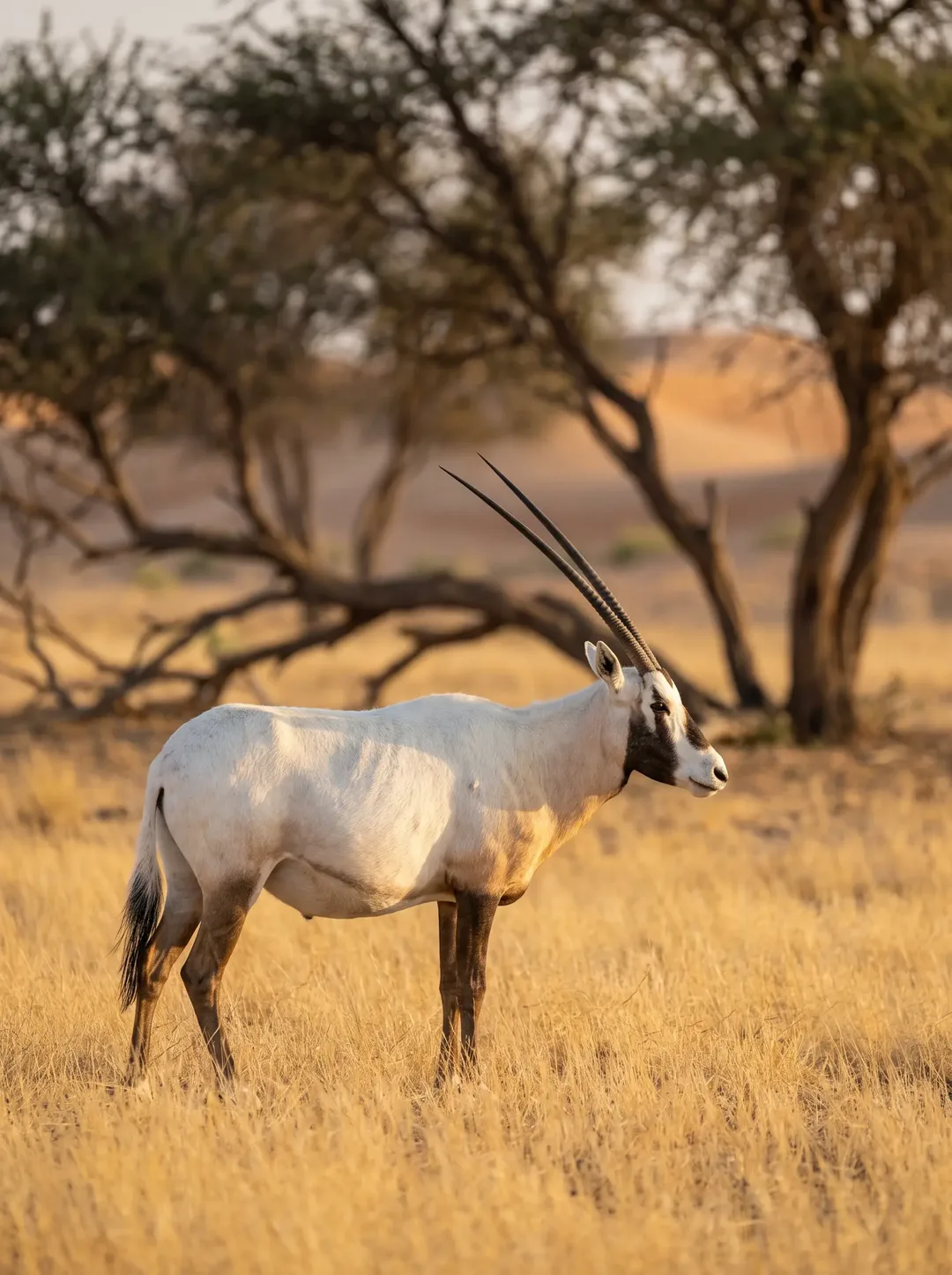
Biodiversity is the variety of plant, animal and microbial species and the variation among them, as defined in Saudi Arabia's Protected Areas Implementing Regulation. In the Kingdom it is the remit of the National Center for Wildlife (NCW), the national focal point for the Convention on Biological Diversity, which Saudi Arabia joined on 3 October 2001. This guide brings together what official sources publish on ecosystems and species, protected areas, reintroduction programmes, the Kingdom's international commitments and the threats to its wildlife.
Key facts
- Competent national body: the National Center for Wildlife, part of the Ministry of Environment, Water and Agriculture system.
- Convention on Biological Diversity: accession on 3 October 2001; party since 1 January 2002.
- Protected areas: 36 areas covering 18.1% of land and 6.49% of sea (September 2024), with a 30% target by 2030.
- Reintroduction: NCW has released more than 10,000 animals of more than 80 species (February 2026).
The national framework: institutions and strategies
The Council of Ministers adopted the National Environment Strategy by Resolution No. 454 of 22/8/1439 AH (8 May 2018). According to the Ministry of Environment, Water and Agriculture (MEWA), it has more than six strategic pillars and 64 initiatives. In December 2020 the ministry launched the Environment Fund and five national centres as the strategy's operating model, among them the National Center for Wildlife, which oversees wildlife and biodiversity conservation programmes, plans the management of protected areas, and runs the breeding and reintroduction centres for endangered animals.
NCW's published strategic objectives include:
- Protecting and developing wildlife and biodiversity across terrestrial, coastal and marine environments.
- Expanding protected-area coverage and ensuring sound management.
- Reintroducing endangered species to their natural habitats.
- Building a knowledge base on wildlife with universities and local and international research centres.
- Stimulating economic diversification, private-sector participation and the use of ecosystem services.
The national biodiversity strategy: Saudi Arabia issued its National Strategy for the Conservation of Biodiversity in 2005. After the adoption of the global biodiversity framework, MEWA and NCW prepared the "National Comprehensive Framework for Biodiversity" with technical supervision from the UN Environment Programme, and posted its final draft, covering 2026–2030, on the Convention's reporting platform in January 2026. The Seventh National Report, posted on the same platform in March 2026, states that adoption of the updated strategy is still in progress.
Ecosystems and species
Saudi Arabia covers about two-thirds of the Arabian Peninsula and lies within two biogeographic realms, the Eurasian and the Afrotropical, which NCW cites as the reason for its varied climate and ecosystems. The ecosystems NCW lists include mountains, deserts, sands, wetlands, coasts, the sea, coral reefs, seaweed, and mangroves such as those at Al-Shura and Qandal.
| Group | What NCW records |
|---|---|
| Mammals | 78 species in 8 orders, including 31 bats, 20 rodents and 14 carnivores. |
| Birds | 550 species: 219 breeding, 280 migratory and 51 vagrant; 27 are globally threatened. The Asir magpie is the only species endemic to Saudi Arabia. |
| Reptiles | 84 lizards and 45 snakes, 9 of them marine, plus 2 freshwater turtles and 5 marine turtles. |
| Amphibians and freshwater fish | 7 amphibians, 4 of them endemic to the Arabian Peninsula; 8 freshwater fish, 4 of them endemic to Saudi Arabia. |
| Terrestrial invertebrates | More than 6,800 insects, 96 spiders, 35 scorpions and 19 ticks. |
NCW notes that some species have gone extinct in the wild in the Kingdom, among them the Asiatic lion, the cheetah and the Saudi gazelle, and that the Arabian leopard is assessed as critically endangered.
NCW's protected-area profiles illustrate the range of habitats:
- 'Uruq Bani Ma'arid: Empty Quarter dunes at the southern end of the Tuwaiq escarpment. NCW describes it as the only place in the world where herds of Arabian oryx live freely without human intervention; it is on the World Heritage List.
- Jabal Shada al-A'la in Al-Baha: about 493 plant species, a quarter of the Kingdom's plant species according to NCW.
- Jurf Raydah in Asir: cloud-forest habitat on the Sarawat escarpment, home to the Asir magpie.
- Ibex Protected Area south of Riyadh: the Kingdom's largest Nubian ibex population, and reintroduced mountain gazelles.
- Farasan Islands in the Red Sea: the richest combined marine and terrestrial biodiversity of any site in the Kingdom according to NCW, with the largest population of Arabian mountain gazelle; in 2021 it became Saudi Arabia's first Biosphere Reserve.
- Jubail Marine Protected Area on the Arabian Gulf: seagrass beds and fish and shrimp nurseries, with dolphins and sea turtles offshore.
Protected areas and the Saudi Green Initiative target
On 10 September 2024 NCW launched the Protected Areas System Plan at IUCN's 10th Regional Conservation Forum, describing it as a roadmap for creating and managing protected areas across the Kingdom. At the time, Saudi Arabia had 36 protected areas covering 18.1% of its terrestrial area and 6.49% of its marine area.
Under the Saudi Green Initiative (SGI), the Kingdom has committed to protecting 30% of its land and sea by 2030, working with international organisations including IUCN. SGI gives the 2021 baseline as 16.9% and says the target will be met through the phased establishment of new protected areas. The actions it lists include:
- Ongoing monitoring and evaluation of protected-area effectiveness and impact.
- Setting the categories and types of terrestrial and marine protected areas to protect critical ecosystems and vulnerable species.
- Consulting stakeholders to develop and implement protected-area master plans.
- Delineating boundaries through field visits, aerial photography and remote sensing.
- Securing budgets to recruit and train protected-area staff.
SGI also announces a 35,877.72 km² no-take marine protected area to be established on the Red Sea coast.
NCW assigns its protected areas to IUCN management categories. Examples:
| Protected area | Region | Area | IUCN category |
|---|---|---|---|
| 'Uruq Bani Ma'arid | Najran and Riyadh | 12,693 km² | VI |
| Farasan Islands | Jazan | 5,772 km² | VI |
| Jubail Marine Protected Area | Eastern Province | 2,400 km² | VI |
| Ibex Protected Area | Riyadh | 1,842 km² | II |
| Jabal Shada al-A'la | Al-Baha | 77 km² | II |
| Jurf Raydah | Asir | 10 km² | IV |
Alongside the areas NCW manages, the Royal Reserve development authorities manage large territories and partner with NCW on releases. See the guide to Saudi Arabia's Royal Reserves.
Breeding and reintroduction programmes
NCW runs two research and breeding centres:
- King Khalid Wildlife Research Center at Thumamah, about 70 km north of Riyadh, established in 1987, with breeding programmes for the Arabian oryx, Arabian sand gazelle, Arabian mountain gazelle, Nubian ibex and Farasan gazelle.
- Prince Saud Al-Faisal Wildlife Research Center, 30 km east of Taif, established in 1986 on 35 km², with breeding programmes for the Asian houbara, Arabian oryx, red-necked ostrich, Nubian ibex, Idmi gazelle and wild hare.
In February 2026 NCW announced that its breeding and reintroduction programmes had released more than 10,000 animals of more than 80 nationally prioritised species, at more than 60 sites including nature reserves, Royal Reserves, national parks and giga-project sites. It said its breeding programmes had grown to 21, up from seven, with a target of 50 by 2030, and that each species is released within its natural and historical range in the Kingdom.
Arabian oryx
According to IUCN, uncontrolled hunting drove the Arabian oryx to extinction in the wild, and the last wild individual is believed to have been shot in Oman in 1972. It was then reintroduced in several countries, Saudi Arabia among them, and in 2011 its Red List status moved from Endangered to Vulnerable: the first species once Extinct in the Wild to improve by three full categories.
Arabian sand gazelle
The sand gazelle was among the first group of animals with which the wildlife conservation programme began at the King Khalid center, established in 1987. Recent releases include 40 sand gazelles, with 20 Arabian oryx and other species, in Prince Mohammed bin Salman Royal Reserve in November 2024, in partnership with the reserve's development authority; and 70 sand gazelles, 30 Arabian oryx and 40 houbara in King Salman bin Abdulaziz Royal Reserve in February 2026.
Arabian leopard
The Arabian leopard breeding programme was transferred to the Royal Commission for AlUla (RCU) under Council of Ministers Resolution No. 38 of 1/5/1440 AH (7 January 2019). RCU describes the subspecies as Critically Endangered in the wild according to IUCN, and runs a breeding centre in Taif that it says is the only active conservation breeding centre for Arabian leopards in the region. RCU is restoring the leopard's prey base by releasing Arabian oryx, gazelles and Nubian ibex into AlUla's reserves, and says it is preparing to reintroduce the leopard into its natural habitats. In June 2023 the UN General Assembly designated 10 February as the International Day of the Arabian Leopard.
International commitments
| Convention or protocol | Accession | Party since |
|---|---|---|
| Convention on Biological Diversity | 3 October 2001 | 1 January 2002 |
| Cartagena Protocol on Biosafety | 9 August 2007 | 7 November 2007 |
| Nagoya Protocol on Access and Benefit-sharing | 10 July 2020 | 8 October 2020 |
The Kunming-Montreal Global Biodiversity Framework: adopted in Montreal on 19 December 2022 at the fifteenth meeting of the Conference of the Parties (COP 15). It sets 4 goals for 2050 and 23 targets for 2030, and all Parties committed to setting national targets to implement it. Its Target 3 calls for at least 30% of terrestrial, inland water, coastal and marine areas to be effectively conserved and managed by 2030.
Saudi Arabia has posted national targets on the Convention's reporting platform since October 2024. They include:
- Protecting 30% of terrestrial, inland water, marine and coastal ecosystems by 2030, through a connected network of protected areas and other effective area-based conservation measures.
- Placing 30% of degraded ecosystems under effective restoration and rehabilitation programmes by 2030.
- Reducing the threat level for known threatened species.
- Controlling invasive alien species and limiting their pathways into the Kingdom.
- Integrating biodiversity values into urban planning and into development-sector policies and plans.
Threats as officially identified
- Habitat loss and fragmentation, and unsustainable resource use: NCW cites these as the cause of severe and rapid declines in many species nationally.
- Overhunting, poisoning of predators and urban expansion: listed by NCW among the threats to mammals.
- Invasive alien species: NCW publishes a list of invasive alien species recorded in the Kingdom, and the Protected Areas Implementing Regulation prohibits releasing or planting them in or around protected areas.
- Illegal wildlife trade: NCW publishes rules to combat it, and lists of predatory species that may not be kept, traded or imported.
- Pollution, climate change and overexploitation, including illegal use: each is the subject of a Saudi national target on the Convention's platform, together with reducing interactions between people and wildlife.
For the Arabian leopard specifically, RCU cites habitat loss, human persecution and dwindling prey.
How can organisations contribute?
- Permits inside protected areas: the Protected Areas Implementing Regulation requires an NCW permit or licence before any activity in a protected area, research and studies included, and prohibits releasing any wild organism there without a licence.
- Private reserves: the regulation allows a private reserve on privately owned land, under an NCW licence and its conditions.
- Biodiversity in planning: the national targets call for biodiversity to be considered in sector plans and urban planning, and for more green and blue spaces in cities.
- Private-sector partnership: the national targets include creating the conditions for partnerships with business on conservation and sustainable use, and increasing finance for biodiversity protection.
- Data sharing: Saudi Arabia aims to develop biodiversity databases and make them available through approved platforms; organisations that collect field data can contribute in coordination with NCW.
Environmental impact assessment and monitoring requirements for facilities are covered in the guide to environmental monitoring in Saudi Arabia.
The Rasmala team's services
The Rasmala team works on biodiversity conservation planning and protected-area management, building on the national frameworks and international standards described in this guide.
How we can help
- Nature and biodiversity conservation: species conservation and recovery plans, biodiversity baselines, and reintroduction feasibility studies and release plans.
- Nature reserve management: management plans, management-effectiveness assessment and IUCN categories.
- Environmental management and monitoring: biodiversity monitoring indicators and protocols.
Guide to Saudi Arabia's Royal Reserves · Guide to environmental monitoring in Saudi Arabia
Sources
- National Center for Wildlife, Terrestrial Wildlife Conservation — ncw.gov.sa/en/terrestrial-wildlife
- National Center for Wildlife, Protected Areas — ncw.gov.sa/en/protected-areas
- National Center for Wildlife, The NCW Strategy — ncw.gov.sa/en/ncw-strategy
- National Center for Wildlife, regulations and species lists — ncw.gov.sa/en/regulations
- National Center for Wildlife, Protected Areas System Plan launch, 10 September 2024 — ncw.gov.sa
- National Center for Wildlife, more than 10,000 animals released under reintroduction programmes, 9 February 2026 — ncw.gov.sa
- Ministry of Environment, Water and Agriculture, launch of the Environment Fund and national environmental centres, December 2020 — mewa.gov.sa
- Protected Areas Implementing Regulation, Umm Al-Qura — uqn.gov.sa
- Saudi Green Initiative, protecting 30% of land and sea — sgi.gov.sa
- Saudi Press Agency, NCW marks World Wildlife Day, 4 March 2026 — spa.gov.sa/en/N2527982
- Saudi Press Agency, 80 endangered animals released in Prince Mohammed bin Salman Royal Reserve, 12 November 2024 — spa.gov.sa/en/N2206301
- Saudi Press Agency, 140 animals released in King Salman bin Abdulaziz Royal Reserve, 5 February 2026 — spa.gov.sa/en/N2506023
- Royal Commission for AlUla, Arabian Leopard Programme & Fund — rcu.gov.sa
- Saudi Press Agency, RCU marks the International Day of the Arabian Leopard, 9 February 2026 — spa.gov.sa/en/N2508485
- IUCN, Red List 2011 update: the Arabian oryx — iucn.org
- Convention on Biological Diversity, list of Parties to the Convention and its Protocols — cbd.int/information/parties.shtml
- Convention on Biological Diversity, Kunming-Montreal Global Biodiversity Framework — cbd.int/gbf
- Convention on Biological Diversity, GBF Target 3 — cbd.int/gbf/targets/3
- Convention on Biological Diversity, COP 15 closing press release, 19 December 2022 — cbd.int
- CBD Online Reporting Tool, final draft of Saudi Arabia's National Comprehensive Framework for Biodiversity (in Arabic) — ort.cbd.int
- CBD Online Reporting Tool, Saudi Arabia's Seventh National Report — ort.cbd.int
- CBD Online Reporting Tool, Saudi national target on protecting 30% of ecosystems (in Arabic) — ort.cbd.int
- Convention on Biological Diversity, Saudi Arabia country profile — cbd.int/countries/profile?country=sa
Sources checked on 5 November 2026. Figures are quoted as published by their sources and may be updated by the competent bodies, so check the National Center for Wildlife's website before relying on them.
