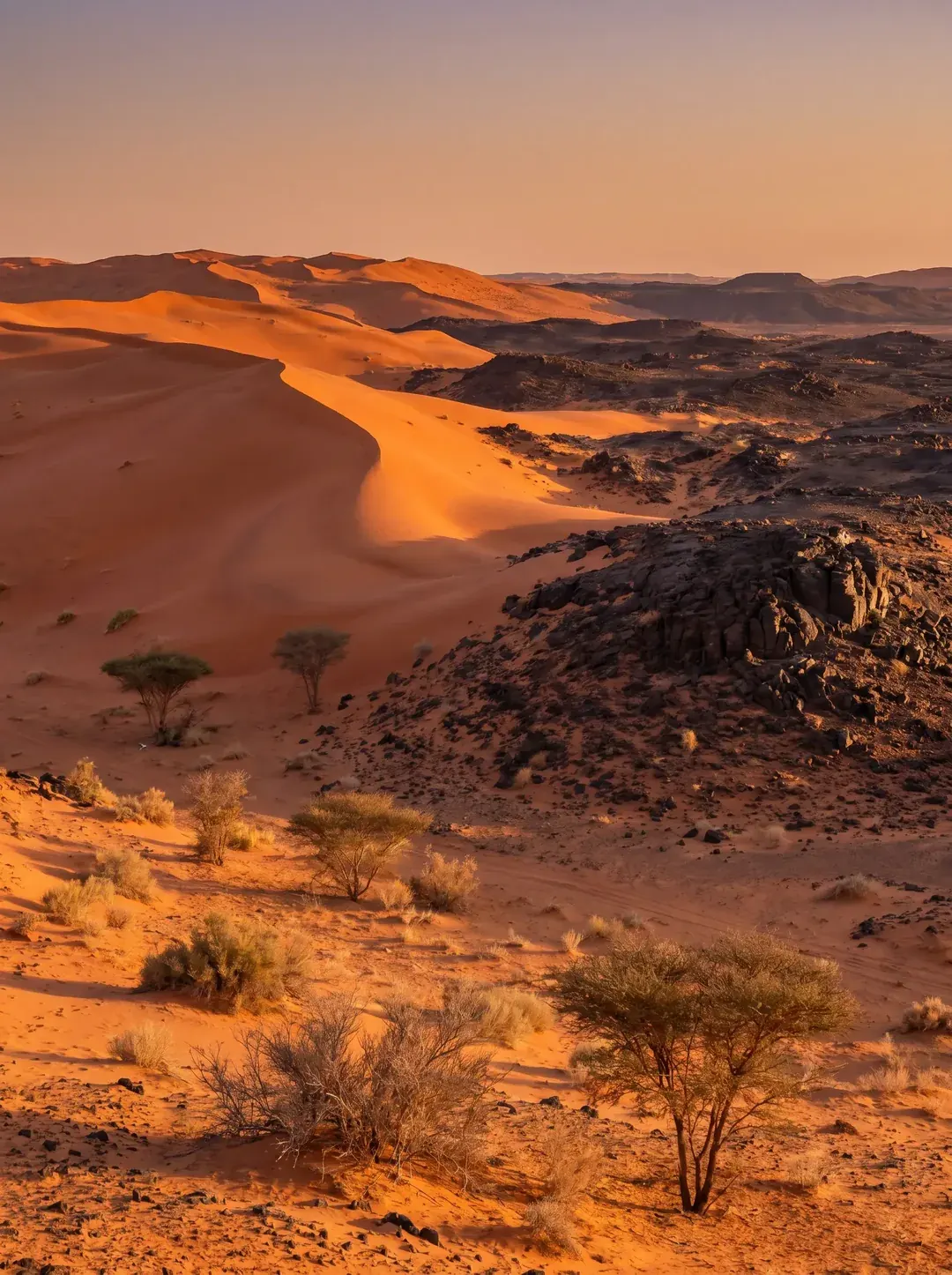
Al-Tubaiq and Harrat Al-Harrah are two nature reserves in the north-west of the Kingdom on the Jordanian border. Both are now part of King Salman bin Abdulaziz Royal Reserve, created by high order No. 47124 of 17/9/1439 AH (June 2018) from the Al-Khunfah, Al-Tubaiq and Harrat Al-Harrah reserves and the areas between and adjacent to them. Al-Tubaiq covers 12,105 km² and Harrat Al-Harrah 13,775 km² according to the King Salman bin Abdulaziz Royal Reserve Development Authority, which manages both.
Key facts
- Al-Tubaiq Reserve: 12,105 km² in the north-west of the Kingdom on the Jordanian border, with the Tubaiq mountains in its west and centre.
- Harrat Al-Harrah Reserve: 13,775 km², a volcanic plateau east of Wadi Sirhan on the Jordanian border.
- Harrat Al-Harrah is the Kingdom's first nature reserve according to the development authority, declared in 1407 AH (1987).
- Since 2018 both reserves have been part of King Salman bin Abdulaziz Royal Reserve.
- Managed by: the King Salman bin Abdulaziz Royal Reserve Development Authority.
Al-Tubaiq Reserve
Al-Tubaiq Reserve lies in the north-west of the Kingdom on the Jordanian border and covers 12,105 km² according to the development authority. Its terrain is rugged: the Tubaiq mountains occupy the western and central parts of the reserve, cut by valleys and ravines, and sand and limestone sedimentary rocks cover much of its surface, according to Saudipedia.
The Tubaiq mountains
The Tubaiq mountains lie in Tabuk Region, north of the Hejaz plateau. They are made of Palaeozoic sandstone, their terrain is extremely rugged, and their highest peak rises to 1,393 m above sea level, according to Saudipedia.
Plants and animals of Al-Tubaiq
- Terrain: mountains, valleys and khabari, according to the development authority.
- Plants: acacia (talh), ghada, damran and arfaj. Saudipedia describes its vegetation as sparse.
- Animals: the Nubian ibex, one of the reserve's most important animals, as well as the sand gazelle and migratory birds.
Harrat Al-Harrah Reserve
The development authority describes Harrat Al-Harrah as the Kingdom's first nature reserve; Saudipedia dates its declaration to 1407 AH (1987). It lies in the north-west of the Kingdom on the Jordanian border, extends east of Wadi Sirhan, and covers 13,775 km².
In Arabic searches the name is sometimes spelled with a final ha in place of the ta marbuta, or shortened to "Al-Harrah reserve"; the development authority uses the name Harrat Al-Harrah.
Landscape of Harrat Al-Harrah
Its surface is a volcanic plateau of black basalt, with low volcanic mountains 800 to 1,150 m above sea level, according to Saudipedia.
Plants and animals of Harrat Al-Harrah
- Plants: perennials including boxthorn (awsaj), tamarisk (tarfa), rimth, ruthah, ghada and arta, according to the development authority; Saudipedia notes that vegetation is concentrated on valley floors and sides.
- Animals: the sand gazelle, Arabian wolf and Arabian fox, according to the development authority.
Al-Tubaiq and Harrat Al-Harrah compared
| Item | Al-Tubaiq | Harrat Al-Harrah |
|---|---|---|
| Area | 12,105 km² | 13,775 km² |
| Location | North-west of the Kingdom on the Jordanian border | North-west of the Kingdom on the Jordanian border, east of Wadi Sirhan |
| Terrain | Sandstone mountains, valleys and khabari | Volcanic plateau and low volcanic mountains |
| Notable animals | Nubian ibex and sand gazelle | Sand gazelle and Arabian wolf |
| Declared a reserve | No date found in an official source | 1407 AH (1987) |
Areas, terrain, plants and animals are from the development authority; elevations and the declaration date are from Saudipedia.
How are the two reserves managed today?
Since 2018 Al-Tubaiq and Harrat Al-Harrah have been part of King Salman bin Abdulaziz Royal Reserve, together with the third founding reserve, Al-Khunfah north of Tayma, which covers 20,450 km² according to the development authority. The King Salman bin Abdulaziz Royal Reserve Development Authority manages all three and issues visit permits through its online platform (permits.ksrnr.gov.sa). For the boundaries of the whole royal reserve and its four regions, see the King Salman Royal Reserve boundaries guide.
Frequently asked questions about Al-Tubaiq and Harrat Al-Harrah
Where is Al-Tubaiq Reserve?
In the north-west of the Kingdom on the Jordanian border. The Tubaiq mountains occupy its west and centre, and Saudipedia places these mountains in Tabuk Region.
How large is Al-Tubaiq Reserve?
It covers 12,105 km² according to the King Salman bin Abdulaziz Royal Reserve Development Authority.
Where is Harrat Al-Harrah Reserve?
In the north-west of the Kingdom on the Jordanian border, east of Wadi Sirhan, covering 13,775 km².
What was Saudi Arabia's first nature reserve?
The King Salman Royal Reserve Development Authority describes Harrat Al-Harrah as the Kingdom's first nature reserve; Saudipedia dates its declaration to 1407 AH (1987).
Are Al-Tubaiq and Harrat Al-Harrah part of King Salman Royal Reserve?
Yes. High order No. 47124 of 17/9/1439 AH designated the Al-Khunfah, Al-Tubaiq and Harrat Al-Harrah reserves and the areas between and adjacent to them as a royal reserve named King Salman bin Abdulaziz Royal Reserve.
Who manages Al-Tubaiq and Harrat Al-Harrah?
The King Salman bin Abdulaziz Royal Reserve Development Authority, which issues visit permits through its online platform.
The Rasmala team's experience
Rasmala's experts, independently or as consultants and specialists to major international consultancies, have worked on strategies and management plans for several royal reserves. We offer development authorities and organisations planning activities or projects inside or next to protected areas:
- Nature reserve management: zoning schemes and use regulations.
- Nature and biodiversity conservation: reintroduction and release plans for species such as the Nubian ibex and sand gazelle.
- Environmental management and monitoring: remote-sensing and field-data protocols for monitoring large areas.
Rasmala does not issue visit permits; those go through the authority's permits platform. To discuss a project, contact the Rasmala team.
King Salman bin Abdulaziz Royal Reserve · Guide to Saudi Arabia's Royal Reserves
Sources
- King Salman bin Abdulaziz Royal Reserve Development Authority, founding reserves page (Al-Tubaiq, Harrat Al-Harrah and Al-Khunfah: area, location, terrain, plants and animals) — ksrnr.gov.sa/en/branch
- Development authority, About the authority (high order No. 47124 of 17/9/1439 AH) — ksrnr.gov.sa/en/about
- Development authority, permits platform — permits.ksrnr.gov.sa
- Saudipedia, King Salman bin Abdulaziz Royal Reserve, Arabic edition (founding reserves and their areas) — saudipedia.com
- Saudipedia, King Salman bin Abdulaziz Royal Natural Reserve (terrain of Harrat Al-Harrah and Al-Tubaiq, Wadi Sirhan) — saudipedia.com
- Saudipedia, the Tubaiq mountains (Arabic) — saudipedia.com
- Saudipedia, timeline of nature reserves (Harrat Al-Harrah declared 1407 AH/1987, Arabic) — saudipedia.com
Sources checked on 5 November 2026. We found no official source for the year Al-Tubaiq was declared a reserve before it joined King Salman Royal Reserve, or for the administrative region of Harrat Al-Harrah, so neither is given.
